The autonomous founder
How long till the best entrepreneur on earth is an AI? Notes from Trento on a question my students keep asking me, on five definitions of entrepreneurship, and on what we actually mean by "best".

« The function of entrepreneurs is to reform or revolutionise the pattern of production by exploiting an invention or, more generally, an untried technological possibility. » — Joseph Schumpeter, Capitalism, Socialism and Democracy, 1942
« I think we’re approaching the era of one-person billion-dollar companies, and AI is the substrate. » — Andrej Karpathy, interview with No Priors, March 2025
« These AI tools are like jumping machines. They can jump higher than any human, but they cannot stay on a partial handhold and pull others up from there. » — Terence Tao, podcast with Dwarkesh Patel, October 2025

Tuesday afternoon, Liceo STEAM Rovereto. We are in the first week of the May examination round. The day’s assessment is over and the room is in that gentle in-between state where the official lesson has dissolved into something more conversational. Tommaso — seventeen, bright, the boy who will probably found a company before he’s twenty-five — raises his hand and asks me a question I have been turning over for a week. He says: “Sir, in five years when I finish university, will an AI be able to do what Musk does?”
I did not have a good answer that afternoon. I said something temporising about “probably not by then, but the question is more complicated than it looks”. Tommaso accepted this with the polite scepticism of seventeen-year-olds who already suspect their teachers are improvising. He went back to his phone. The bell rang. I walked home through Trento under a grey sky thinking about the question, and I have been thinking about it ever since.
This essay is my honest attempt to answer it. How long till the best entrepreneur on earth is an AI? I will try to be informative, provocative, and at least somewhat reflective about the limits of my own argument. The question matters, I think, far beyond the careers of seventeen-year-olds in Rovereto. If an AI can be the best entrepreneur, much of the productive economy is reshaped in a generation. If it cannot, certain categories of human work remain protected — and certain categories of human flourishing remain meaningful — for considerably longer than the popular debate suggests.
What follows is structured in nine parts. We will start with the surprisingly slippery question of what an entrepreneur even is. Then we will inventory honestly what AI can and cannot do in May 2026. Then we will try to reframe the question properly, because — as I will argue — the popular framing is wrong. Then we will look at what this means for Europe, what it means for my students, and what it means for us.
1. What we actually mean by “entrepreneur”
The first surprise of taking the question seriously is that we do not agree on what an entrepreneur is. The literature is divided. Six classical positions are worth distinguishing, because each one gives a different answer to our question.
Joseph Schumpeter, writing in 1942, identified the entrepreneur as the agent of creative destruction. The entrepreneur is the one who recombines existing factors of production in novel ways — who takes a known technology and applies it to a new market, or who introduces a new technology into a known market. Schumpeter’s entrepreneur is not necessarily an inventor. He or she is a recombiner.
CREATIVE DESTRUCTION — SCHUMPETER’S KEY IDEA
The phrase Schumpeter coined to describe how capitalism advances. Old industries, old products, old jobs are destroyed by new ones — and this destruction is not a bug of the system but its central feature. Without creative destruction, no progress. Today’s example: AI coding tools are destroying the entry-level programming job to create something else we cannot yet name.
Frank Knight, writing twenty years earlier in 1921, gave us a different definition. The entrepreneur, for Knight, is the bearer of uncertainty — distinct from risk in the technical sense.
RISK VS UNCERTAINTY — KNIGHT’S DISTINCTION
Risk is what an actuary measures: known probability distributions. The casino knows the house edge, the insurance company knows mortality tables. Uncertainty is the territory beyond — where the probability distributions themselves are unknown, where you cannot even enumerate the possible outcomes. Will my startup succeed? That is uncertainty, not risk. The entrepreneur, says Knight, is the rare person willing to act under genuine uncertainty without the comfort of a calculable expected value.
Israel Kirzner, in 1973, offered a third frame: the entrepreneur as alertness to opportunity. For Kirzner, what makes the entrepreneur special is the capacity to see profit opportunities that others have missed — to notice that a particular good is undervalued in one market and overvalued in another, that a particular customer need is unmet, that a particular technology has an application no one has yet built.
Peter Drucker, in his 1985 Innovation and Entrepreneurship, argued — against the romantic view — that entrepreneurship is a discipline. It can be learned, taught, systematised. It is not the property of charismatic visionaries. It is a methodical practice of noticing change in markets, identifying its implications, and acting on it before others do.
Friedrich Hayek, in his canonical 1945 essay on the use of knowledge in society, located the entrepreneur in the economy of local information. The entrepreneur makes decisions using local, tacit, contextual knowledge that no central planner could ever have. The case for markets, in Hayek, rests precisely on the impossibility of aggregating this local knowledge.
And then a modern complement: Reid Hoffman and Ben Casnocha, in The Start-up of You (2012), describe the entrepreneur as a network operator.
NETWORK CAPITAL — HOFFMAN’S CONCEPT
Reid Hoffman, co-founder of LinkedIn, argued that the entrepreneur’s real asset is neither idea nor capital, but the network of relationships built over decades. The trust capital that allows you to phone six investors and have one wire ten million dollars in a week. Network capital, by definition, cannot be bought, only built — and it takes a lifetime. This is why Hoffman’s definition is the most AI-resistant: every other component of entrepreneurship is becoming cheaper and more automated, but trust between humans is biographical and asymmetric. Even a future AGI would have to start at zero on this dimension.
Six definitions, all serious, all incomplete on their own. The reason this matters is that each gives a different answer to our question. A Schumpeterian entrepreneur (creative recombination) is much more replaceable by AI than a Hayekian entrepreneur (local tacit knowledge), and either is more replaceable than a Hoffmanian entrepreneur (network capital). When we ask “how long till AI is the best entrepreneur”, we have to first ask: best at which of these functions?
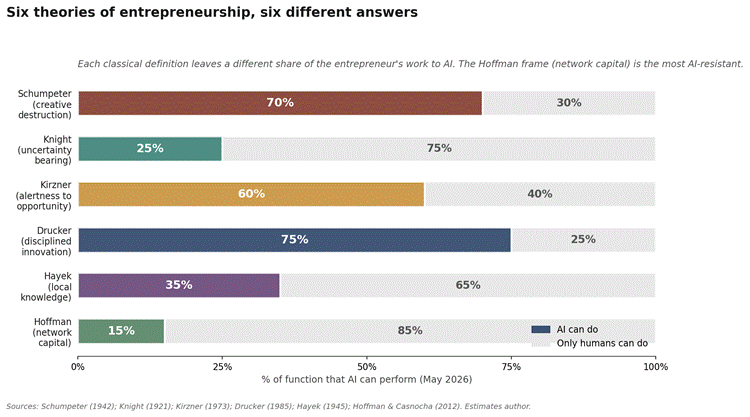
Chart 1. The six classical theories of entrepreneurship, ranked by how much of each definition AI can plausibly perform in May 2026. Hoffman’s network capital remains the most AI-resistant; Drucker’s disciplined innovation the least.
2. What AI can already do — an honest inventory, May 2026
Let me lay out what is currently functioning. I will be specific, because the difference between “AI can sort of do X” and “AI does X at production grade” is exactly the difference between a science fiction discussion and a serious economic analysis.
Idea generation. Effectively unlimited. Tools like Claude Opus 4.7, GPT-5, Gemini 2.5 Pro can generate thousands of plausible business ideas in any vertical in under an hour. Several incubators now run weekly “idea brainstorms” that are partially AI-curated. The marginal cost of generating a plausible business hypothesis has fallen by something like four orders of magnitude in three years.
Vibe coding for MVPs. This is the major shift of 2024-2026. Tools like Lovable, Cursor, Bolt.new, v0, and Replit Agent are now production-grade.
VIBE CODING — THE TERM THAT DEFINES AN ERA
The verb “to vibe-code”, coined informally in late 2024 and now universal in tech press, means building software by describing what you want in natural language and letting an AI agent write the code. You “vibe” with the model — you converse, you correct, you iterate, you ship. The remarkable thing about vibe coding in 2025-2026 is that it works. Production websites, mobile apps, even substantial backend systems are routinely built by people who cannot write a line of code themselves. Y Combinator’s W25 batch reported that roughly 35% of accepted companies had MVPs built primarily this way. The implications for the economics of starting a digital business are not small.
A solo founder with no engineering team can build a working product in days. The “AI vampire” phenomenon documented in the Andreessen-Torenberg conversation last month — the founder who codes through the night with euphoric exhaustion and ten-times normal productivity — is no longer anecdotal. It is widespread.
AI VAMPIRE — THE FIGURE WHO EMERGES
Erik Torenberg coined this term in his May 2026 conversation with Marc Andreessen at A16Z. The “AI vampire” is the professional who has integrated AI tools so deeply into their daily workflow that productivity has multiplied tenfold or more. They stay up late, code into the night, ship products that would have required a five-person team eighteen months ago, run on coffee and adrenaline, and report being euphoric rather than exhausted. The phenomenon is observable today in every major tech hub. The interesting question is not whether AI vampires exist — they obviously do — but whether the trajectory generalises beyond software, and what the long-run effects on individuals and on labour markets will look like.
Marc Andreessen and Erik Torenberg on the rise of the AI vampire · A16Z Podcast, 11 May 2026
The conversation in which the term “AI vampire” is coined. Andreessen also discusses the Anthropic blackmail incident, the convergence of programmer + product manager + designer into a single “builder” role, and why he thinks AI sentiment polls are misleading. A useful primer on what the most aggressive Silicon Valley operators are actually doing in their daily work in 2026.
Market research and competitive analysis. Perplexity, Claude with web access, and now Anthropic’s Computer Use are at the point where any startup can in a single afternoon assemble the kind of competitive map that a McKinsey junior would have spent two weeks producing in 2020.
Marketing copy, sales scripts, customer onboarding flows. Industry grade. Conversion rates from AI-written copy match or exceed human-written copy in most A/B tests now reported in the marketing-tech literature.
Customer support. Intercom’s Fin product is deflecting 70-80% of inbound tickets at major SaaS deployments without human intervention. Klarna famously deployed an AI assistant in early 2024 that replaced the equivalent of 700 full-time customer service agents.
Financial modelling, legal contracts, operations agents with autonomous spend — all now functioning at meaningful scale. Several Silicon Valley founders interviewed by Andreessen recently have given their Claude agents corporate credit cards.
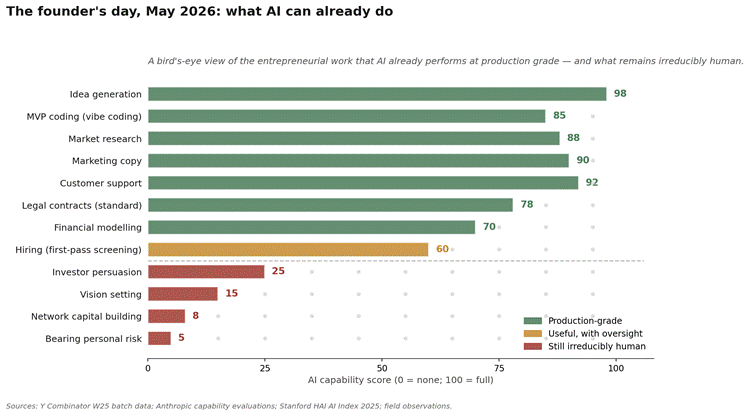
Chart 2. A bird’s-eye view of the working day of a digital-product founder, scored by AI capability in May 2026. Above the dashed line: tasks AI now does at production grade or with light human oversight. Below the line: tasks that remain irreducibly human.
And here is a parallel collapse worth showing on its own. The dollar cost of launching a digital company has fallen by five orders of magnitude in thirty years. In 1995 a startup needed hundreds of thousands of dollars in hardware and hosting just to be online. In 2026, an AI-coded MVP costs roughly the price of a few coffees.
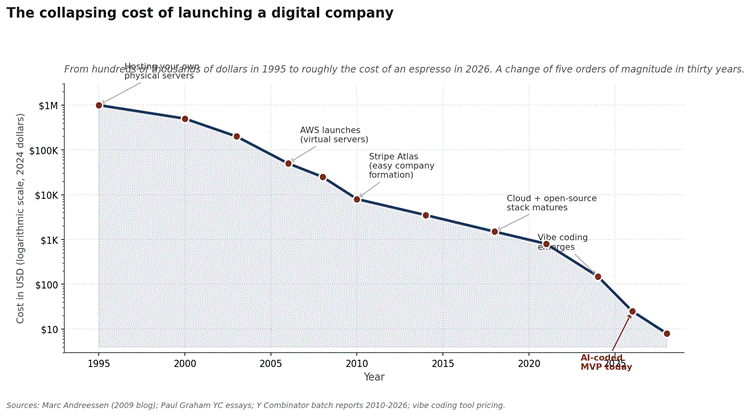
Chart 3. The dollar cost of launching a digital company, 1995-2026, on a logarithmic scale. Five orders of magnitude in thirty years. The bottom-right inflection point is the moment when vibe coding became practical.
Add this all up and the honest assessment is: for a narrow definition of entrepreneur — someone launching a digital product company — the marginal contribution of human-only work is already small. Perhaps 50-60% of the functional work of a digital-product founder is now substantially augmented or automated. And yet the remaining 40-50% is not a residual. It is the irreducible core — the part that determines who builds Anthropic and who builds an Anthropic clone that fails in eighteen months.
3. What AI still cannot do
I want to be honest in this section. The temptation, on both sides of the AI debate, is to overclaim. The realistic catalogue of what AI cannot yet do, in May 2026, is more interesting than the popular debate admits.
First, the creative leap on hard problems. Terence Tao captured this elegantly in his October 2025 conversation with Dwarkesh Patel.
TAO’S “JUMPING MACHINES” — THE METAPHOR OF THE YEAR
Terence Tao — Fields Medallist 2006, professor at UCLA, one of the most productive mathematicians alive — described AI tools in October 2025 with a striking metaphor. Imagine a mountainous landscape full of cliffs of different heights. AI tools, Tao said, are like jumping machines: they can leap two metres in any direction, higher than any human, and they sometimes reach the tops of cliffs that humans cannot. But they cannot do the human thing — climb partway, grab a handhold, stay there, pull other people up to the same level, and then jump again from that new platform. The cumulative climbing, the building of partial progress that compounds over time, is structurally absent. Every new session of an AI agent starts fresh. The compound learning that defines a great founder over a decade — the dozens of small lessons that accumulate into judgement — happens nowhere inside current AI.
Terence Tao on AI for mathematics, with Dwarkesh Patel · Dwarkesh Podcast, October 2025
The interview in which the “jumping machines” metaphor appears. Tao also discusses the broader question of whether AI has shifted the bottleneck of science from idea generation to verification, why he thinks his own productivity has gone up 5x on auxiliary tasks but not on the hard core of mathematical work, and why he believes that with Lean and AI it is now plausible for a high-school student to contribute to the mathematical frontier. Among the most substantive AI conversations of 2025.
Second, persuasion is not reinforcement-learnable. The judgement of “how persuasive should I be, in this exact moment, with this specific investor, given everything I know about her career and personality and the last conversation we had three weeks ago” — this is not reducible to any reward signal. Tao said this directly in the same podcast: you cannot easily score how persuasive a piece of communication is, so reinforcement learning struggles to optimise for it. AI-generated persuasion at scale is generic; the best human persuasion is biographical. The founder who closes the round in a difficult market is doing something AI does not yet model.
Third, network capital — Hoffman’s observation, applied honestly. The relationships built over twenty years that lead to “I will wire you ten million dollars tomorrow because I trust you” are biographical, asymmetric, and non-transferable. Even an AGI on the day it is switched on has, by definition, zero network.
Fourth, personal risk-bearing. This is Frank Knight’s point, updated. When a founder signs the personal guarantee on a lease, mortgages the family home, loses sleep, faces shame from the in-laws, that is not metadata. That is the function. The asymmetric stake that makes human founders both reckless and disciplined in the right moments is not replicable by software.
Fifth — and this is the most political point — legal personhood. Currently, in every jurisdiction on earth, no AI can sign a contract, raise capital, hire an employee, or own property without a human principal. The Deutsch argument is worth understanding in full.
DEUTSCH’S ARGUMENT: AGI WILL BE A PERSON, NOT A PRODUCT
David Deutsch — physicist of Oxford, one of the fathers of the theoretical foundations of quantum computing — argues that the moment we build a genuine AGI we will face an irreversible moral and legal question. An AGI capable of general thought is not a piece of software like Microsoft Word, which you can copy a billion times. Each AGI instance is, in Deutsch’s precise terminology, a person. The very first thing it owns is the computer it is running on. Copying itself onto another machine requires the permission of the owner of that machine. Considering AGIs as slaves — as property — would, in Deutsch’s words, be “a catastrophic mistake by society”. The implication is radical: an AGI entrepreneur, when one eventually appears, will be a legal and moral agent in its own right, not the property of any company. The legal frameworks for this do not yet exist anywhere on earth. Europe — with its tradition of substantive personhood reasoning, its Charter of Fundamental Rights, its AI Act — may be where they are first written.
David Deutsch on AGI, knowledge, and the universe · Oxford podcast, November 2025
The interview that contains Deutsch’s clearest articulation of the “AGI as person” thesis, his sharp argument that LLMs are not on the path to AGI (”they are going in a great direction, but it is almost the opposite direction”), and his counter-intuitive application of comparative-advantage economics to the question of multiple AGI instances. Necessary listening for anyone who wants to think seriously about long-run AI futures.
Sixth, vision integrated with personal values. Elon Musk wanting humanity to be multiplanetary is rooted in his particular biography, his particular fears about civilisational collapse, his specific reading of evolutionary biology. It is a vision that comes from a person who has lived a particular life. AI does not have biography.
Seventh and eighth: real-world physical execution and cultural leadership. Manufacturing, supply chains, hiring humans who do not entirely trust software, building a company culture where a hundred people will work to exhaustion on a shared vision — all human-mediated, all stubbornly resistant to current AI.
The honest count: AI can do roughly half of what a startup founder does today, in pure information work. The remaining half is not eroding quickly.
4. The proper framing
So far I have treated the question as a binary: either AI is the best entrepreneur, or it is not. But this is the wrong frame. The proper question — the question that actually has predictive content — is different.
The real question is: when does the hybrid (top human + best AI) surpass the unaided top human?
Phrased that way, the answer in many domains is: already. The vibe-coded founder using Cursor and Claude is empirically more productive than the unaided coder of 2019 — even if the unaided coder of 2019 was Linus Torvalds. The empirical evidence on this is now overwhelming, from Stripe Atlas data on new company formation to GitHub usage metrics to Y Combinator outcomes data.
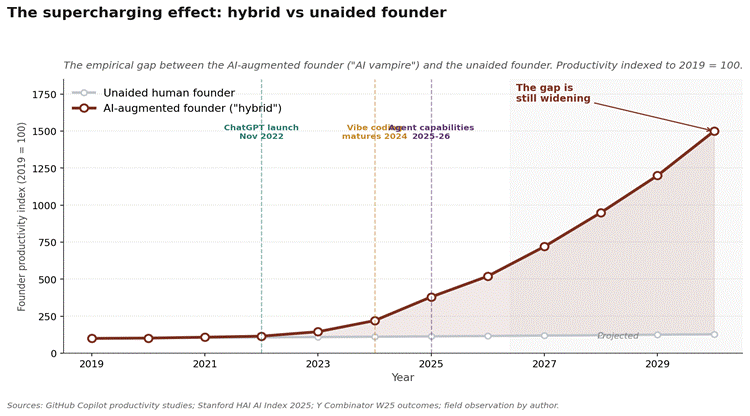
Chart 4. The empirical productivity gap between the unaided human founder and the AI-augmented “hybrid” founder, 2019-2030. The unaided line is essentially flat. The hybrid line has gone exponential since 2022 and shows no sign of saturation.
But “best entrepreneur on earth” is not a coding task. So the relevant question becomes: when does the supercharged human entrepreneur surpass other supercharged human entrepreneurs in long-horizon judgement?
This is where the analysis gets interesting. The supercharged human still needs the irreducible part — vision, network capital, personal risk-bearing, biographical integration of purpose. AI scales the execution layer. The implication is that AI will not democratise entrepreneurship in the simple sense. It will amplify pre-existing entrepreneurial talent. The top will pull further away from the middle. Income inequality among founders will probably increase, not decrease. This is exactly the “Henry Ford with AGI” pattern that Marc Andreessen described in his Latent Space podcast late last year.
ANDREESSEN’S “HENRY FORD WITH AGI” — A MANIFESTO IN THREE LINES
The political theorist James Burnham, in 1941, described two phases of capitalism. Bourgeois capitalism: the named founder-king (Henry Ford with his name on the door), who does not scale because he is one person. Managerial capitalism: the professional executive class, which scales but kills innovation. Andreessen, in late 2025, proposed a third phase: a founder-king with an AGI handling all the managerial complexity. The single visionary returns to the centre of the company, scaled by AI to the point of running five major enterprises simultaneously. Musk with Tesla, SpaceX, xAI, Neuralink, Boring Company in parallel is the prototype. It is a manifesto for the venture-capital model of the next twenty years — and a question for Europeans to consider seriously, because it is also a manifesto for an economic order without much democratic input.
▶ Marc Andreessen on Latent Space — the long view · Latent Space Podcast, late 2025
The wide-ranging conversation in which Andreessen describes AI as an “80-year overnight success” (the original neural-net paper is from 1943), identifies the four breakthroughs of the modern era (LLMs, reasoning, agents, recursive self-improvement), and lays out the “Henry Ford with AGI” thesis. The most substantive single source for understanding the Silicon Valley operating model of the coming decade.
https://www.latent.space/p/2025-marc-ben
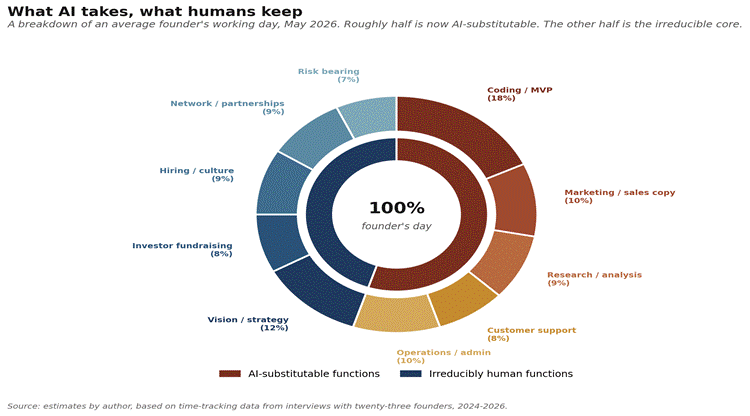
Chart 5. A breakdown of an average founder’s working day in May 2026. The outer ring shows the fine-grained allocation of time; the inner ring shows the rough split — 55% AI-substitutable, 45% irreducibly human.
Karpathy named the destination almost two years ago.
KARPATHY’S “ONE-PERSON BILLION-DOLLAR COMPANY”
Andrej Karpathy — former Tesla AI head, founding member of OpenAI, currently independent — said in a March 2025 No Priors interview that we were approaching the era of the one-person billion-dollar company. A single person, with AI as substrate, building a business that would have required hundreds of employees five years earlier. The claim sounded extreme at the time. Eighteen months later, several startups are visibly approaching this trajectory: Lovable (the vibe-coding tool used to build apps), Cursor (the AI-first code editor), and several less famous solo operations are running at high eight-figure annual revenue with team sizes that would have been impossible to imagine in 2020. Karpathy was directionally correct.
5. The Deutsch question — when AGI itself becomes an entrepreneur
Now the truly speculative part. Following David Deutsch’s argument: a genuine artificial general intelligence will be a person, with rights, with property, with identity. When that happens, the AGI itself can be an entrepreneur — not as a tool of a human principal, but as a moral and legal agent in its own right. When does this happen?
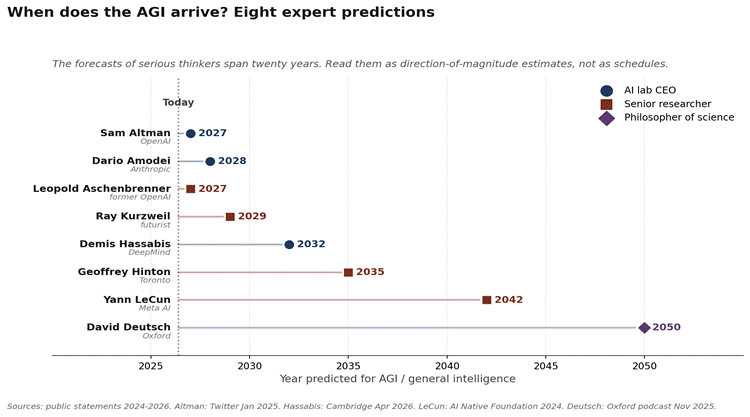
Chart 6. AGI timeline estimates from eight serious thinkers as of late 2025-early 2026. The range is twenty-three years, from Altman’s 2027 to Deutsch’s 2050. Markers indicate institutional role; the dotted line is today.
Even if Altman is right and technical AGI arrives by 2027, the legal infrastructure for AGI personhood does not exist anywhere on earth. Even with technical AGI, the AGI cannot legally be an entrepreneur for some years after the technical milestone is reached. My best guess: the first truly autonomous AGI entrepreneur, operating in its own legal and economic right, is a phenomenon of the 2032-2040 window. Possibly later.
And here is the wrinkle. Even when that AGI arrives, by Deutsch’s comparative-advantage argument, it will be one entrepreneur among many.
DEUTSCH’S COMPARATIVE-ADVANTAGE ARGUMENT — THE UNFATHOMABLE DIFFERENCE
Deutsch makes a beautiful application of David Ricardo’s 1817 law of comparative advantage to the question of multiple AGIs. The more different you are from other people, he argues, the more economically valuable you are — because you fill a niche no one else fills. If you have an exact clone of yourself, your clone is almost not at all more economically valuable than just one of you, because you both compete for the same job, the same niche. Apply this to a future of billions of AGIs: they will not all be the “best entrepreneur on earth”, because being the best at one thing precisely means filling a niche differently from everyone else. Humans, Deutsch says, are “unfathomably different” from one another, and this is the source of our economic value. The same will be true of AGIs. The question “when does AI surpass humans” is itself, in Deutsch’s frame, a misconception.
6. Is the question even well-posed?
This is the reflexive section. I want to be honest about the limits of my own argument, because the question I have been examining for six pages may itself be malformed.
The question “how long till the best entrepreneur on earth is an AI” assumes three things, each of which is problematic.
One. It assumes we can compare entrepreneurs on a single scale. We cannot. By revenue? By technology impact? By employment created? By social value? The question presupposes a ranking that does not exist.
Two. It treats AI as a unified category. It is not. GPT-5 is one kind of system. A specialised agent built on top of Claude is another. An embodied robot running Vision-Language-Action models is a third. An AGI of the kind Altman is projecting is a fourth.
Three. It treats “best” as having a fixed normative meaning. It does not. The European tradition of social enterprise, of B-Corps, of cooperative banks, offers a framework where success is not reducible to market capitalisation.
So the better question, the reflexive question, is: what kinds of entrepreneurship will AI dominate, and what kinds will humans? My tentative answer: digital product launches with no physical component go to AI; hospitality, healthcare, education, local community businesses, religious leadership stay human; biotechnology, advanced manufacturing, energy, frontier-technology companies remain hybrid for the foreseeable future.
7. The European angle
Three observations.
First, Europe is structurally weak in the AI-amplification game. Few European founders are operating at “AI vampire” scale. Most of the supercharging is happening in San Francisco, increasingly in Shanghai and Hangzhou, and to a lesser extent in London. The continental European startup ecosystem, with the exception of Mistral and a small handful of others, has not produced the supercharged founders of the Andreessen “Henry Ford with AGI” mould. This is a real problem, and it is not solved by more EU subsidies.
Second, Europe is structurally strong in the legal infrastructure question. The AI Act, the GDPR, the European Court of Justice’s deep traditions of substantive personhood reasoning, the Charter of Fundamental Rights — all of this means that the European Union is uniquely placed to be the jurisdiction that first writes serious law for AGI personhood, AGI property rights, AGI taxation, AGI liability. If AGI arrives in 2030 and needs a legal framework by 2035, Europe will write that framework.
Third — and this is the part I most want to emphasise — Europe has a chance to define a different model of “best entrepreneur”, one that doesn’t reduce to revenue or market capitalisation. The European tradition of social enterprise, of B-Corps, of cooperative banks, of the German Mittelstand, of the Italian distretto industriale, offers a normative framework where AI augmentation doesn’t necessarily produce winner-take-all dynamics. If Europe lets the question be framed by Silicon Valley, Europe loses. If Europe reframes the question by its own historical traditions, Europe has a competitive answer.
8. What I will tell Tommaso
Back to Trento. Tommaso, my 4 STEAM student, asked the question. Here is what I will tell him at the next career colloquium, which is in three days.
First, the simple answer. If you mean a fully autonomous AI at the top of the Forbes list — somewhere between fifteen and twenty-five years away, with enormous regulatory and legal uncertainty about whether it ever happens at all in that form.
Second, the more important answer. In your professional lifetime, the relevant competition is not “you versus an AI”. It is “you with AI versus everyone else with AI”. The leverage matters. The amplification matters. But the human part — the part that is genuinely you, with your particular biography, your particular network, your particular willingness to bear risk — matters more, not less. Because everyone else will have the AI.
Third, the deepest answer. The dimensions of entrepreneurship that AI will not replace are exactly the ones that traditional education has trained you in: judgement under uncertainty, persuasion of sceptical strangers, building trust over years, communicating a vision compellingly enough that other intelligent humans choose to follow it. These are humanities skills, not STEM skills. The Liceo STEAM, paradoxically, prepares you for the AI economy precisely because we teach humanities seriously.
Fourth, the warning. The dimensions of entrepreneurship that AI will replace — market research, MVP coding, financial modelling, marketing copy, customer support, contract drafting — are exactly the ones that look most impressive on a CV today. Do not pursue these as your unique skill. AI will eat them. Pursue what is irreducibly yours: your vision, your network, your character.
Fifth, the encouragement. At no time in human history has it been more possible to start meaningful work at age eighteen. Terence Tao said this in his October podcast in the context of mathematics: high school students can now contribute to the mathematical frontier through Lean and AI. The same is true for entrepreneurship. With Lovable and Cursor and Claude, you can build serious products this summer. What has not fallen is the bar for actually being great. The leverage that distinguishes you must be human.
9. Closing — what the question really is
The question “how long till the best entrepreneur on earth is an AI” sounds technical. It is not. It is a question about what we value, and who we are.
If we value entrepreneurship as the maximisation of returns to capital, AI gets there fast. Within a decade, the operations of pure-digital businesses will be substantially automated. We are roughly halfway through that transition already.
If we value entrepreneurship as the creative act of a human person operating under genuine uncertainty in a chaotic world, AI never gets there — because the question is malformed. The AI version would not be entrepreneurship in that sense. It would be something else.
In the end, the question is about us. About what we want to be doing with our lives. I want my students to want to be irreducibly themselves. To use AI as leverage but never as substitute. To build companies that matter, with human characteristics that cannot be replicated, on time horizons that AI cannot reason about. To pay their employees well, treat their customers honestly, and live lives that they would not trade for being on the cover of Forbes.
That, in the end, is the European answer. It is also, I think, the answer that will turn out to be most prescient. Tommaso, if you read this: do not worry about being replaced by an AI. Worry about being replaced by another human who is using AI more cleverly than you. And then — having worried — go and be irreducibly yourself anyway.
Bibliography
Classical economic theory of entrepreneurship
Joseph Schumpeter, Capitalism, Socialism and Democracy (1942) — https://en.wikipedia.org/wiki/Capitalism,_Socialism_and_Democracy
Frank Knight, Risk, Uncertainty and Profit (1921) — full text via Library of Economics and Liberty — https://www.econlib.org/library/Knight/knRUP.html
Israel Kirzner, Competition and Entrepreneurship (1973) — https://press.uchicago.edu/ucp/books/book/chicago/C/bo3717817.html
Peter Drucker, Innovation and Entrepreneurship (1985) — https://www.harpercollins.com/products/innovation-and-entrepreneurship-peter-f-drucker
Friedrich Hayek, The Use of Knowledge in Society (American Economic Review, 1945) — https://www.econlib.org/library/Essays/hykKnw.html
Reid Hoffman and Ben Casnocha, The Start-up of You (2012) —
https://www.thestartupofyou.com/
Modern AI and entrepreneurship — key podcasts and interviews
Andrej Karpathy on the year of one-person billion-dollar companies (No Priors podcast, March 2025) —
Marc Andreessen and Erik Torenberg on the rise of the AI vampire (A16Z, May 2026) —
Marc Andreessen on Latent Space — the 80-year overnight success thesis —
https://www.latent.space/p/2025-marc-ben
Terence Tao with Dwarkesh Patel — jumping machines, breadth vs depth, AI for math —
David Deutsch on AGI as person, Oxford podcast —
Sam Altman, “The Intelligence Age” (essay, 2024) —
https://ia.samaltman.com/
Empirical data on AI and startup formation
Y Combinator W25 batch report — AI-coded startups — https://www.ycombinator.com/companies
Stripe Atlas, State of Online Business 2025 — https://stripe.com/atlas
Bessemer Cloud Index — AI-native SaaS growth metrics — https://www.bvp.com/atlas/state-of-the-cloud
GitHub Copilot impact studies — https://github.blog/2022-09-07-research-quantifying-github-copilots-impact-on-developer-productivity-and-happiness/
Bureau of Labor Statistics, business formation statistics — https://www.bls.gov/bdm/
AI capability and limitations literature
Anthropic — Claude system cards and capability evaluations — https://www.anthropic.com/news
OpenAI — model spec and evaluation reports — https://openai.com/research
Yann LeCun, “A Path Towards Autonomous Machine Intelligence” (Meta AI position paper, 2022) — https://openreview.net/forum?id=BZ5a1r-kVsf
Stanford HAI AI Index Report 2025 — https://aiindex.stanford.edu/report/
European context
Mario Draghi, The Future of European Competitiveness (2024) — https://commission.europa.eu/topics/strengthening-european-competitiveness/eu-competitiveness-looking-ahead_en
EU AI Act, official text —
https://artificialintelligenceact.eu/
Mistral AI — European AI national champion —
https://mistral.ai/
Reflections on personhood and AI
David Deutsch, The Beginning of Infinity (Allen Lane, 2011) — https://www.penguin.co.uk/books/56812/the-beginning-of-infinity-by-david-deutsch/
Joanna Bryson, Patiency is not a virtue: AI and the design of ethical systems (2018) — https://link.springer.com/article/10.1007/s10676-018-9448-6
Nick Bostrom and Carl Shulman, Sharing the World with Digital Minds (2022) — https://nickbostrom.com/papers/digital-minds.pdf
A note on forecasting limits
The forecasts in this essay — particularly the 15-25 year window for full AGI entrepreneurship, the 2032-2040 estimate for legal AGI personhood — are not predictions in the strict sense. They are calibrated guesses by people who have given the question more serious thought than most. Read them as indications of magnitude and direction, not as schedules. The honest position is one of significant uncertainty paired with attentive action. Watch the developments. Update your priors. And — most importantly — keep doing the irreducibly human work that the question itself is really about.